

- StarkWare is exploring whether Starknet should move from an Ethereum Layer 2 to an independent post-quantum Layer 1 blockchain.
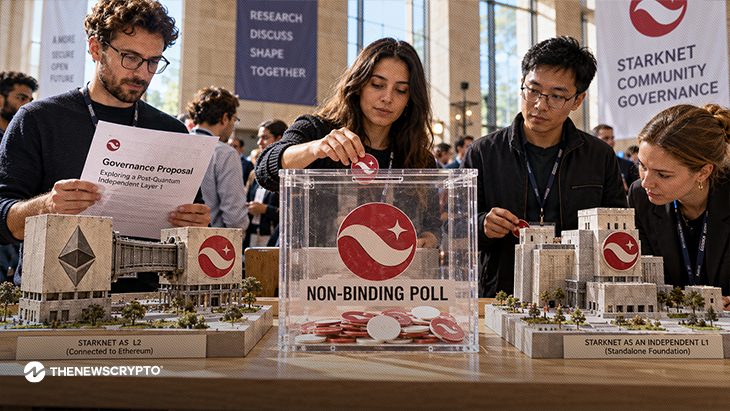
- The 7-day, non-binding governance poll will guide the next steps. A Yes vote triggers formal research, a No vote keeps the work within the L2 framework, and a Neutral vote leaves the proposal open.
StarkWare announced on October 8 that it is actively exploring the possibility of Starknet evolving from an Ethereum Layer 2 into an independent post-quantum Layer 1 blockchain. A non-binding governance poll is now live for STRK holders to weigh in. It is running for seven days, with results visible immediately at close.
This is not a final decision, and what the community says next will determine whether this goes further or stays on the shelf. Also, the core argument is quantum security. Starknet already runs on hash-based STARK proofs and supports native account abstraction.
That means the parts of the network under Starknet’s own control are already provably resistant to quantum computers. User accounts can adopt post-quantum signatures without needing a protocol upgrade.
The problem is the parts Starknet doesn’t control. Functions like data availability and the Ethereum bridge depend on Ethereum’s infrastructure. Their quantum security is tied to Ethereum’s own upgrade timeline. Moving to an independent L1 would allow Starknet to set its own security requirements for those functions without waiting on Ethereum.
What’s Already Decided and What Is Not?
Some things are fixed regardless of which direction the vote goes. STRK remains the token; no new token will be created. Bridges from Ethereum to Starknet will stay open either way.
The proposal does not include a transition date, a consensus mechanism, a data availability design, or a migration plan. StarkWare has said publicly which direction it leans, but the technical architecture of an independent L1 has not been finalised or presented to the community.
What Happens After the Vote?
The poll runs for seven days, and the three outcomes are possible. A Yes result triggers a formal research effort, leading to more detailed proposals and further community votes. A No result means the post-quantum work continues within the L2 framework. A Neutral result keeps the thread open until the outstanding questions have answers.
A Yes vote is not approval of a transition. It’s approval of spending more resources to study whether a transition makes sense.
Significantly, the proposal puts Starknet in a unique position in the L2 landscape; it’s the first major Ethereum scaling network to seriously explore an independent quantum-resistant L1 path. Whether the community backs further research or not, the conversation itself signals that the next phase of blockchain security is moving from theoretical to operational planning faster than most expected.
Crypto Market Highlights
South Korea’s Financial Sector Faces Tighter Cybersecurity Rules After Data Exposure