
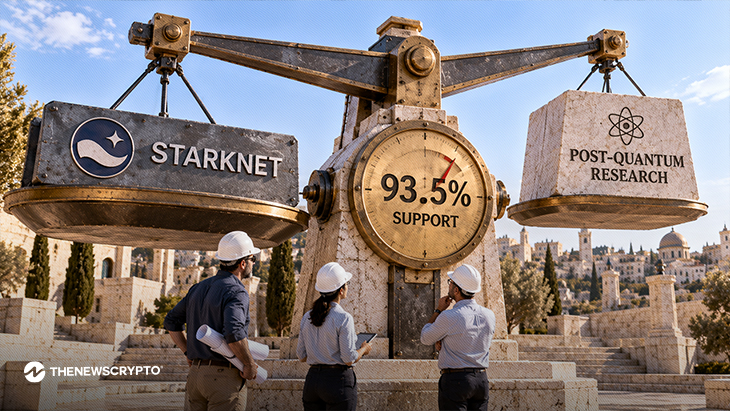
- Starknet non-binding Snapshot poll received 93.52% support from voting power across more than 2,800 wallets over seven days.
- StarkWare abstained to avoid influencing the vote, and any transition to an independent Layer 1 will require a separate governance vote after the research and design phase.
Starknet token holders have given StarkWare and the Starknet Foundation a clear mandate to begin researching a potential transition from an Ethereum Layer 2 into an independent, quantum-resistant Layer 1 blockchain. The non-binding Snapshot poll ran for seven days and closed today, with 93.52% of voting power in favour, across more than 2,800 participating wallets.
StarkWare abstained from the vote deliberately, stepping back so the community could make the call without the developer’s influence skewing the result. This vote authorises research, not transition. Formal approval of any move to L1 will require a dedicated governance vote once the research and design phase concludes.
In addition, StarkWare plans to release a draft whitepaper in November, and a joint working group from StarkWare. The Starknet Foundation will publish findings to the governance forum as they develop.
Why Independence From Ethereum Is Being Considered?
The reasoning behind the proposal is security. Specifically, quantum security. Starknet is already well-positioned for a post-quantum future. Moreover, its core protocol runs on hash-based STARK proofs, which are resistant to quantum computing attacks.
Its programmable accounts can adopt post-quantum signature schemes without requiring a protocol upgrade, a flexibility most networks don’t have. In StarkWare’s NIST-informed assessment of cryptographic agility, Starknet is the only network assessed with evidence across all eight measures.
The problem is what Starknet inherits from Ethereum. The bridge and data availability layer both depend on Ethereum’s security, and Ethereum is targeting December 2029 for a quantum-resistant L1, with wider migration extending beyond that timeline.
As long as Starknet operates as an L2, its path to full post-quantum security is tied to Ethereum’s pace. An independent L1 removes that dependency entirely. StarkWare is aiming to build a security framework capable of responding to quantum computing threats by 2027.
What Stays the Same
STRK remains the native token regardless of which direction the research points. There are no plans to issue a new token. For holders and builders on Starknet, the community vote changes the research direction, not the day-to-day network operation or token structure.
Also, the research group begins work now, with updates shared progressively through the governance forum. If the findings support moving forward, detailed proposals will follow, and the community will vote again before anything is finalised.
Significantly, a 93.5% mandate from token holders signals strong community alignment behind long-term security infrastructure, which tends to attract institutional attention over time, even before a transition is formally approved.
Crypto Market Highlights
Railway Pauses All Deployments After Customer Environment Variable Breach