


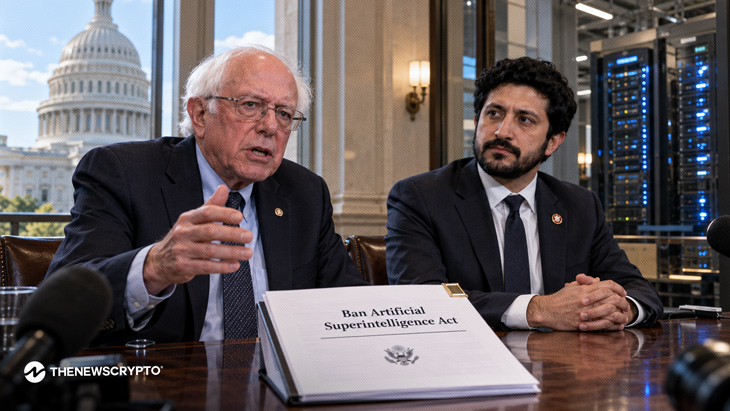
- Sen. Bernie Sanders and Rep. Greg Casar introduced legislation to ban artificial superintelligence and temporarily pause development of advanced AI systems.
- The bill would establish a cabinet-level Department of Artificial Intelligence to oversee advanced AI systems and enforce federal safety rules.
Sen. Bernie Sanders and Rep. Greg Casar officially unveiled legislation Wednesday, September 23, that would permanently ban the development and deployment of artificial superintelligence and temporarily halt development of the most advanced AI systems.
The bill, provided to The Associated Press ahead of its introduction, would also create a new Department of Artificial Intelligence to oversee advanced AI systems and establish federal safety rules.
“Do we really want to develop a super intelligence that when it becomes smarter than human beings could act independently of human control? I don’t think we do,” Sanders, said in an interview with AP.
Even, in a X post on Sep. 22, Sanders argues that scientists and industry leaders had raised concerns that AI could eventually “surpass human intelligence and operate outside human control.”
He called on President Donald Trump and Chinese President Xi Jinping to negotiate a treaty to pause AI development and ban superintelligence ahead of the Trump-Xi summit which is starting today.
Bill Would Require Federal Approval for Advanced AI Systems
Under the proposed legislation, artificial superintelligence would include AI systems that exceed human cognitive abilities or have capabilities that could allow them to undermine or disempower humanity or governments. The bill would pause development of advanced AI until federal safety standards and a model-review process are established.
Once the framework is in place, advanced AI systems would require federal approval before deployment. The proposed department would monitor frontier AI systems throughout their lifecycle and oversee the removal of dangerous capabilities or the destruction of systems classified as artificial superintelligence.
The legislation also proposes an Artificial Intelligence Advisory Board made up of AI experts to provide scientific and technical advice to the new department. Violations could result in penalties of up to 20 years in prison for individuals, while companies could face dissolution under the bill’s proposed corporate penalties.
The proposal comes as AI regulation remains unsettled in Washington. AP reported Wednesday that the bill faces challenges in the Republican-controlled Congress, where lawmakers have struggled to reach agreement on broader AI regulations.
The legislation would also direct the U.S. to pursue international agreements, coordination with allies and export controls aimed at preventing artificial superintelligence from being developed outside the country.
Highlighted Crypto News: