

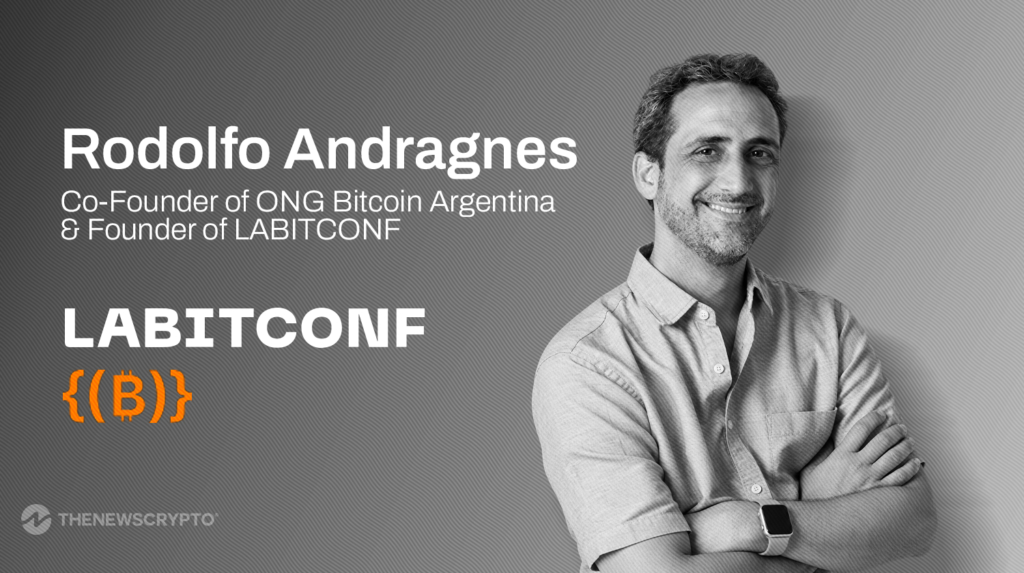
Rodolfo Andragnes discusses Bitcoin’s evolution, growing institutional participation, self-custody, stablecoins, regulation and how digital-asset adoption is developing across Latin America.
Bitcoin has changed significantly since Rodolfo Andragnes, co-founder of ONG Bitcoin Argentina and founder of LABITCONF, first became involved with it in 2011. What was once a small community outside the traditional financial system has grown into a global market, with Bitcoin ETFs, institutional investors and governments now part of the conversation.
For Andragnes, however, Bitcoin’s importance goes beyond its price or its growing presence in traditional finance. The LABITCONF founder has spent more than a decade advocating for Bitcoin in Argentina, building communities and taking part in discussions around its use and regulation.
In an exclusive interview with TheNewsCrypto, Andragnes spoke about Bitcoin’s early years, the rise of institutional adoption, why he continues to see self-custody as important, and where he believes regulators still misunderstand the technology. He also discussed stablecoins, financial privacy, the U.S. crypto regulatory debate and what years of bringing the industry together through LABITCONF have taught him.
TheNewsCrypto (TNC): Can you tell us about your journey in Bitcoin and what initially convinced you that it could become important?
Rodolfo Andragnes (RA): Back in 1997 I’d already started a project with the same name and owned the domain bitcoins.com and I first got involved with it in 2011. What made me realize this mattered was how it reshaped the way I understood Money, Power and where value, Trust and its role really come from. They’re simple concepts on the surface, but we rarely stop to consider how powerful they are, or how an entirely new kind of society could be built around them.
TNC: You entered the Bitcoin ecosystem more than a decade ago, when it was still largely outside the mainstream. Looking back, what has changed most in the way people understand Bitcoin, and what misunderstanding still remains?
RA: People still struggle to see this as more than an investment – to grasp that it’s really about recognizing that the monetary and power system is broken, and that Bitcoin is a key part of the solution. What’s easier now, at least, is finding clear, digestible information in multiple languages to help people start down that path of discovery.
TNC: Right now, Bitcoin ETFs and institutional adoption have become two of the biggest trends in the market. Do you think this institutionalization is changing what Bitcoin represents, or simply creating new ways to access it?
RA: Not at all. Bitcoin is free for anyone to adopt. Some people adopting it that way doesn’t stop others from adopting it directly or self-custodying it themselves. It’s simply another entry point for people who aren’t quite confident to take that step, or for companies that have no other way to do it. That said, it’s obviously not the same as holding your own Bitcoin.
TNC: As more financial institutions enter the market, how important is it to preserve the ideas of self-custody, decentralization and financial independence that originally attracted people to Bitcoin?
RA: As important as ever, maybe more so. Bitcoin is the only asset in the world, and the only sound money, with guaranteed scarcity, and that awareness keeps spreading. Why would anyone hand that over to a third party and have to ask permission to use it? Real ownership only exists through self-custody.
TNC: You’ve been involved in Bitcoin advocacy in Argentina for more than a decade, including discussions with regulators. What is one thing policymakers still misunderstand about Bitcoin today?
RA: Almost everything. For starters, they assume Bitcoin and crypto are the same thing, that blockchain is inherently secure, that it’s just another financial asset, just to name a few. These are all fundamental misunderstandings. There’s no such thing as “the blockchain” – there are many different networks, each with its own risks and problems.
And unlike nearly everything else out there, Bitcoin isn’t a promise or a claim on something, the way a financial asset, a stablecoin or a tokenized instrument is – or the way yield-bearing tokens, infinitely issued coins, or entity-controlled cryptocurrencies are. So the basic concepts they work with are simply wrong, and no law or regulation to date has actually drawn that distinction.
TNC: With the CLARITY Act becoming an important part of the U.S. crypto regulatory debate, how do you think it could affect the broader crypto industry?
RA: The U.S wields enormous power globally, which can shape the decisions and regulations of other countries. The CLARITY Act would have brought more clarity to the crypto world as a whole, even though it doesn’t affect Bitcoin at all. I think it could have given a potential boost for developing projects operating under clear, favorable regulatory frameworks in the US. Stille, the CLARITY Act is just one of several steps the current US administration is trying to take in that direction.
TNC: From your experience working with regulators in Argentina, where do you think regulation can help the crypto industry, and where can it create problems?
RA: Regulation helps companies understand and define the legal and operational boundaries they need to work within, while also giving them legitimacy as recognized players and better access to relationships with banks and other institutions. That doesn’t mean regulation is automatically positive. Often, the requirements are so strict or impractical that smaller projects can’t survive them, or companies simply choose to leave the market instead.
TNC: At the same time, stablecoins have become one of the most widely used parts of the digital-asset ecosystem, particularly in emerging markets. From what you have observed in Latin America, what problems are stablecoins solving that Bitcoin alone has not solved as effectively?
RA: That’s comparing apples and oranges, as my math teacher used to say. Stablecoins are essentially a version of the dollar, gaining blockchain’s traceability, global reach and speed, but also taking on greater execution risks, control, state abuse or system failures. Bitcoin, on the other hand, definitely doesn’t try to be a dollar. It’s something fundamentally different: the only asset in the world with certainty of scarcity that’s also divisible, transferable, unforgeable and portable, all hallmarks of sound money, while also being digital and programmable. No other asset has managed to combine all of that.
TNC: You have also raised concerns about digital currencies that could give governments greater visibility or control over financial transactions. As payments become increasingly digital, how do you see the balance between financial regulation and individual privacy?
RA: Well, that path is already mapped out, and it ties into my previous answer. CBDCs and stablecoins represent that scenario, though it’s hardly unfamiliar territory, since the whole world already runs on financial transactions that can be, and often are, traced or blocked. Stablecoins and CBDCs simply take that control even further. Bitcoin, by contrast, can’t be frozen or blocked unilaterally: it’s a pseudonymous system, and it’s entirely up to each person whether to reveal their identity to states or companies.
TNC: Looking across Latin America today, which differences between countries do you think are most important for understanding how crypto adoption will develop in the region?
RA: Every country is its own world, honestly, but a few key factors stand out: how much people trust and have adopted the financial system, past experiences with inflation, the level of international payments, how heavy the tax burden is, and so on. Together, these shape how willing citizens are to use cryptocurrencies, treat Bitcoin as a store of value, or embrace circular economies.
TNC: You have spent years building communities and bringing people together through LABITCONF. Beyond the conference itself, what have you observed from watching developers, entrepreneurs, investors and policymakers interact in the same room that you would not necessarily see from following the industry online?
RA: That’s the big difference: going into meatspace – meaning meeting in person, flesh and blood – not only allows you to understand what’s happening but also builds relationships that let you find partners, save time, debate and dig deeper live on the topics you care about with others who share the same interests.
TNC: Finally, after more than a decade in Bitcoin, what do you think is the biggest question the Bitcoin and digital-asset industry still needs to answer?
RA: I´m not sure it needs an answer. I think it’s mostly a matter of time before society fully recognizes Bitcoin as the best asset for storing value, thanks to its unique qualities as money, especially heading into an AI-driven future built on abundance. As for crypto more broadly, I expect it will keep gaining ground, gradually being adopted for more and more solutions and control.
Disclaimer: The information provided in this interview article is for informational purposes only. It is not intended to be, nor should it be construed as, investment advice, financial guidance, or a recommendation to make any specific decisions. Readers are encouraged to conduct their own research.