

- DogeOS has opened its public testnet, bringing EVM-compatible smart contracts to the Dogecoin ecosystem.
- DOGE will power transaction fees, while developers can build DeFi, trading, stablecoin, and gaming applications on DogeOS.
DogeOS has opened its public Chikyū testnet, bringing an EVM-compatible smart contract layer to the Dogecoin ecosystem through a zero-knowledge rollup.
The testnet went live on September 30, giving developers a place to build and test applications on top of Dogecoin without changing the network’s underlying Layer 1. DOGE is used as the native token for transaction fees on DogeOS.
The launch gives Dogecoin developers access to Ethereum-compatible smart contract infrastructure. Developers can use familiar tools including Hardhat, Foundry and Remix, while the Chikyū testnet currently operates with chain ID 6281971.
DogeOS Brings DeFi and Other Applications to Dogecoin
DogeOS is designed to support applications that are not available directly on Dogecoin’s base layer, including decentralized exchanges, lending platforms, perpetual trading, stablecoins, prediction markets and games. Several projects are already building on the testnet, including Barkswap, Superposition Finance, Derps, Split Markets and USDoge.
The network targets about 300 transactions per second, compared with roughly 30 transactions per second on Dogecoin’s Layer 1. DogeOS also uses a separate application layer so that smart contract activity can run without requiring changes to Dogecoin’s core network.
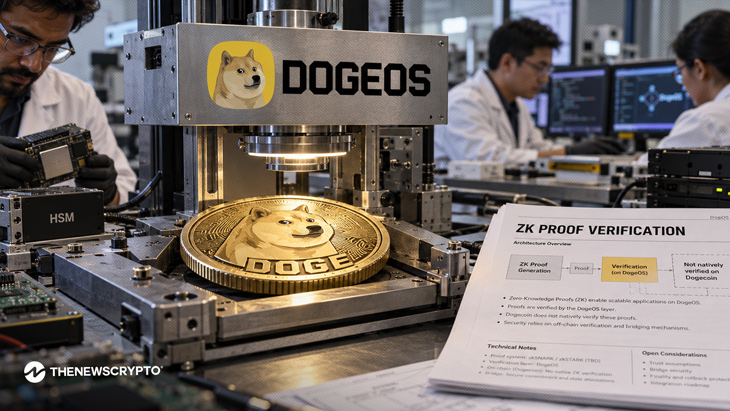
The zero-knowledge rollup is designed to settle its state to Dogecoin. However, Dogecoin does not currently verify DogeOS’s zero-knowledge proofs directly. The testnet instead uses a trusted execution environment, validators and a permissioned sequencer, with bridge state transitions requiring valid proofs along with validator and TEE signatures.
DogeOS has previously proposed a Dogecoin Core upgrade that would allow the base network to verify ZK proofs directly, but that upgrade has not yet been implemented.
For DOGE, the immediate change is therefore on the application side rather than the base blockchain. The cryptocurrency can be used to pay fees for smart contract activity, while developers get an EVM-compatible environment for building applications around Dogecoin.
DogeOS has not announced a mainnet launch date. The current public testnet is being used to allow developers to build and test applications before the project moves toward mainnet.
DOGE was trading around $0.0976 on October 1, up about 2.5% over the previous 24 hours, according to CoinMarketCap data at the time of writing.