

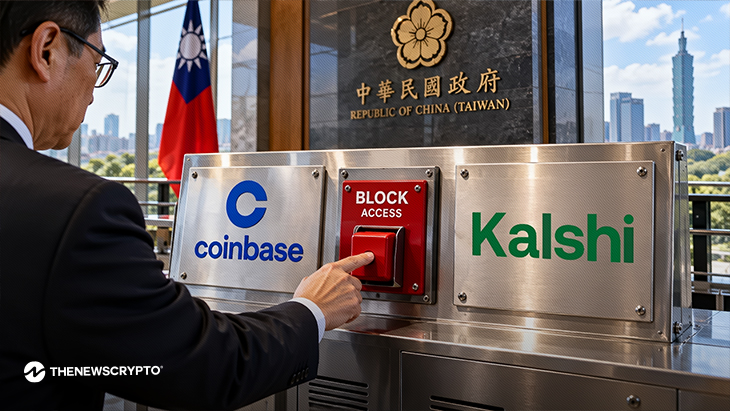
- Taiwan restricts Coinbase and Kalshi following a New Taipei court order requested by the Criminal Investigation Bureau.
- Election gambling concerns drive the move, with investigators citing suspected violations of the Public Officials Election and Recall Act ahead of Taiwan’s November 28 local elections.
Taiwan has blocked domestic access to Coinbase and Kalshi, with a New Taipei court authorising the country’s communications regulator and internet registry to restrict both platforms. The Criminal Investigation Bureau, which sought the order, cited suspected violations of the Public Officials Election and Recall Act, a law that prohibits operating gambling for profit based on the outcome of an election or recall.
The move comes weeks ahead of Taiwan’s November 28 local elections, where residents will vote for mayors, city councillors, and village chiefs across the island. It’s the first island-wide electoral test for President Lai Ching-te since he took office in 2024, and the results could offer an early read on the political landscape heading into the 2028 presidential race.
Why Both Platforms Got Caught?
The connection between Coinbase and Kalshi explains why both ended up in the same court order. Coinbase works with Kalshi to offer prediction market contracts on election outcomes, including contracts reportedly tied to Taiwanese local races. That partnership put both platforms in the crosshairs of the same legal action simultaneously.
In addition, some Coinbase users in Taiwan reported being unable to access the site as of Wednesday. Coinbase said it was investigating the reported access issues. Kalshi, for its part, stated it does not allow trading in Taiwan, though the court order stands regardless.
The Law Behind the Block
Taiwan criminalises election wagering, and a 2023 amendment to the election act sharpened the penalties. Participants in election betting can face up to six months in prison. Operators running such gambling for profit face up to five years.
Besides, the Criminal Investigation Bureau said the restrictions were requested to protect election integrity and prevent what it described as overseas interference, though it stopped short of giving further details.
Authorities have not alleged that either Coinbase or Kalshi handled funds from China. That said, the Taiwanese government has separately flagged concerns about money from China potentially flowing through underground financial channels to influence the November vote, and has stepped up scrutiny of illicit financial activity ahead of the election.
Coinbase and Kalshi are not the only platforms that have found themselves blocked in Taiwan over election betting concerns. Moreover, Polymarket, Kalshi’s main rival, is also inaccessible in the country.
Furthermore, the pattern signals that as prediction markets grow, regulators in jurisdictions with strict election wagering laws are moving to cut off access rather than wait for platforms to self-regulate.
Crypto Market Highlights
MSCI Sets November Deadline for Crypto Treasury Index Changes