


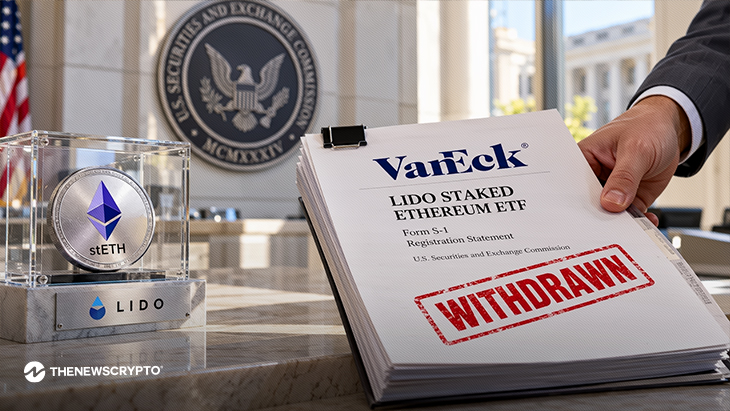
- VanEck requested withdrawal of its proposed Lido Staked Ethereum ETF.
- The fund was designed to track stETH’s price performance after expenses.
- The SEC had not declared the registration effective, and no shares were issued or sold.
VanEck has asked the U.S. Securities and Exchange Commission (SEC) to withdraw its registration for the proposed VanEck Lido Staked Ethereum ETF, ending plans to launch a fund that would have given investors exposure to Ethereum’s liquid-staking market through a traditional exchange-traded product.
In a Form RW filing dated October 14, 2026, VanEck Digital Assets said it no longer intends to proceed with the planned distribution of the fund’s shares. The request was made under Rule 477 of the Securities Act of 1933 and concerns the registration statement initially filed on October 16, 2025, under file number 333-290918.
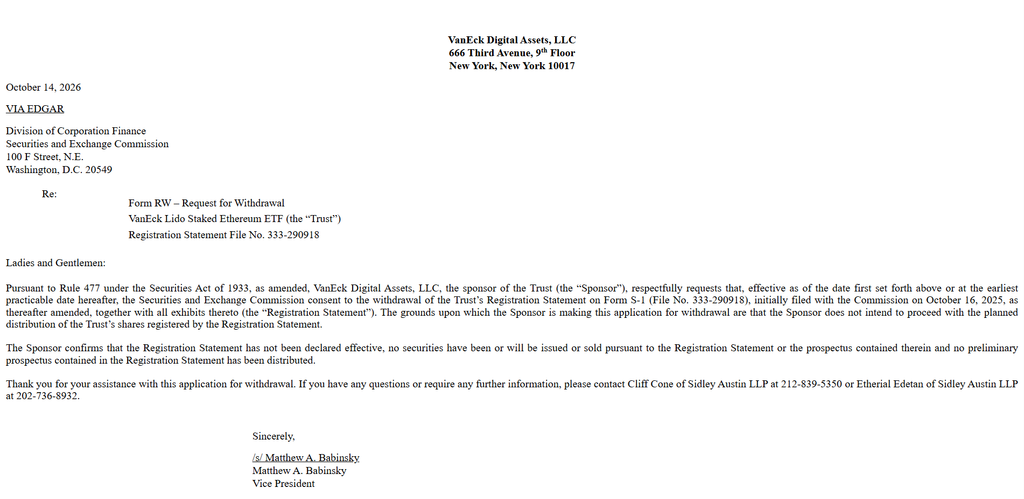
The withdrawal request does not represent an SEC rejection. VanEck confirmed that the registration statement had not been declared effective, no securities had been issued or sold, and no preliminary prospectus had been distributed. The proposed ETF therefore never reached the stage of offering shares to investors.
How the Proposed ETF Would Have Worked
The original filing outlined a fund designed to track the price performance of Lido Staked Ether (stETH), minus operating expenses. The trust would have held stETH directly, rather than holding Ether (ETH) itself or Lido’s separate governance token, LDO.
StETH represents Ether deposited through Lido’s liquid-staking protocol, along with staking rewards associated with that Ether. Unlike conventional staking, which can leave assets locked while they earn rewards, liquid staking provides a token that holders can use or trade while retaining exposure to the staked assets and their associated risks. The proposed fund would have allowed investors to obtain exposure to stETH through ETF shares instead of holding the token directly.
The filing described a passive investment vehicle that would have valued its shares daily using a stETH benchmark rate. It also stated that the trust would not use leverage or derivatives to pursue its investment objective. However, the proposed fund never became operational, so investors did not gain access to this structure.
VanEck has not publicly explained why it decided to withdraw the application. The filing also does not say whether the asset manager plans to introduce another liquid-staking investment product.
The decision ends this specific ETF proposal, but it does not change Lido’s protocol or the status of stETH held by existing users. Any future VanEck product would require its own announcement and, where applicable, regulatory filings.