



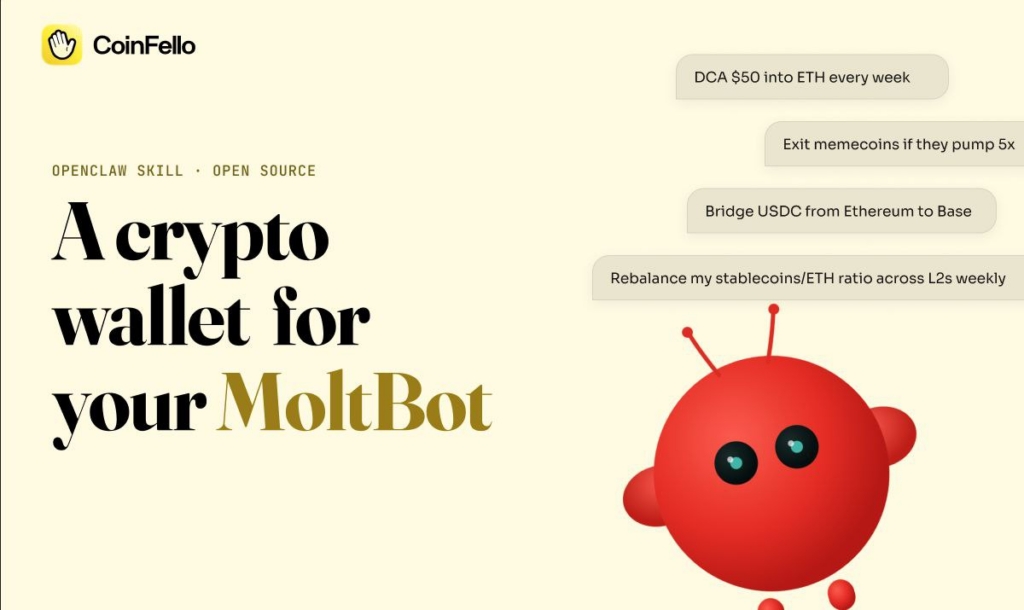
- Moltbots are able to give other agents, such as CoinFello, narrowly defined delegations to act on their behalf via the use of the CoinFello OpenClaw skill.
- A user’s Moltbot has the ability to provide CoinFello, and ultimately other compatible agents, just the permissions that are essential to execute a certain job.
A cooperation between MetaMask and CoinFello has resulted in the release of the open-source OpenClaw skill. CoinFello is an artificial intelligence agent that is designed for interacting directly with any EVM smart contract. The newly implemented integration makes it possible for Moltbots, which are personal AI agents that operate on OpenClaw, to conduct onchain transactions in a safe manner by using delegated smart wallet permissions.
During the launch, a new framework is shown that allows for the connection of artificial intelligence agents with cryptocurrency wallets while still allowing users to retain custody of their private keys. Moltbots are able to give other agents, such as CoinFello, narrowly defined delegations to act on their behalf via the use of the CoinFello OpenClaw skill. This is accomplished by the utilization of ERC-4337 smart accounts and ERC-7710 delegations using the MetaMask Smart Accounts Kit. When compared to the current state of affairs, in which agents often store private keys or API credentials in plain text, this marks a considerable leap in the security of agentic wallets.
In this system, the concept of least privilege is consistently applied. A user’s Moltbot has the ability to provide CoinFello, and ultimately other compatible agents, just the permissions that are essential to execute a certain job. This ensures that no agent is granted access to a wider range of wallets than is specifically needed. When a user sends in a request using plain language, CoinFello transforms the instruction into a delegated transaction and then verifies it in an evaluation layer before putting it into action.
“If we want agents to participate meaningfully in the onchain economy, we need a security model that is better than handing an autonomous system a private key,” said Brett Cleary, CTO at CoinFello. “The CoinFello Skill introduces hardware-isolated keys and fine-grained delegations, giving AI agents a secure way to execute transactions while helping bootstrap onchain capabilities for the broader agent ecosystem.”
The announcement comes at a time when the OpenClaw ecosystem is seeing significant expansion. Additionally, the OpenClaw repository on GitHub has topped 150,000 stars and 22,000 forks over the course of the last two months, and the number of npm downloads has surpassed 416,000 in the preceding thirty days.
A significant number of AI agent wallets have, up until this point, provided the agent with direct access to a private key or API credential. This has resulted in the disclosure of important secrets inside the agent’s runtime and has created a broad attack surface.
There are also more recent designs that make an effort to reduce this risk by using trusted execution environments (TEEs) on the server side; nonetheless, these designs continue to depend on centralized infrastructure.
CoinFello skill, takes a different approach than the others. While actions are carried out via fine-grained ERC-7710 delegations, the signature key remains on the device with which the user is interacting directly. It is possible for agents to carry out acts without ever having access to the private key.
Moltbots are able to carry out a broad variety of blockchain tasks by responding to natural language cues when they are equipped with the CoinFello skill. Swapping between ERC-20 assets, bridging between EVM networks, interfacing with non-fungible tokens (NFTs) such as ERC-721 or ERC-1155 tokens, staking, lending, automated rebalancing of token portfolios, and the execution of multi-step trading strategies are some of the features that are supported.
Claude Code and OpenClaw environments are both compatible with the CoinFello OpenClaw skill, which was developed based on the Agent Skills definition. The implementation is made available to developers under the MIT license, which enables them to freely install, change, and contribute to the skill inside their own AI agent setups.
However, CoinFello emphasizes that the system is intended to be open and flexible in its configuration. Moltbots have the ability to delegate rights to any onchain agent that is compatible with them, despite the fact that CoinFello is the default Web3 agent. It has been stated by the firm that an expansion of permissions frameworks and deeper interfaces with the MetaMask Smart Accounts Kit would be the primary focus of future development in order to offer comprehensive portfolio management functionalities.
Due to the fact that developers have been experimenting with autonomous software agents that are able to communicate with decentralized networks, there has been an increase in interest in the confluence of artificial intelligence agents and crypto infrastructure in recent months. By combining natural language interfaces with onchain execution, the CoinFello OpenClaw skill intends to offer a safe basis for this developing category of cryptocurrencies.
Interactions with smart contracts may be explained, carried out, and automated with the help of CoinFello, an artificial intelligence agent. Developed for self-custody, the platform is now accessible to end users in a private alpha version, and developer versions are anticipated to be released in the near future. CoinFello is compatible with EVM networks, utilizes EigenAI to provide a self-custodied artificial intelligence environment, and integrates the MetaMask Smart Accounts Kit to provide users with management over their assets.