


- ETH has formed a new Tom DeMark Sequential buy signal.
- Ethereum is currently trading near the $1.7K mark.
Ethereum has formed a new Tom DeMark (TD) Sequential buy signal on the one-hour chart, suggesting that the recent selling pressure may abate. Right present, the critical support level is $1,750. Buyers may push ETH toward the $1,800 barrier level if it stays above this level.
Moreover, a move above would strengthen short-term bullish sentiment and indicate that the buying interest is returning. Upon ETH falling below $1,750, the current buy signal would lose credibility, increasing the risk of another wave of selling. In that circumstance, traders may hunt for lower support levels before a comeback.
Ethereum affects sentiment in the larger altcoin market since it is the second-largest cryptocurrency asset by market capitalisation. A strong comeback might boost trust in popular altcoins. Conversely, a breakdown below support may reinforce caution.
Will Ethereum Momentum Build or Lose?
At the press time, Ethereum was trading near the $1,770 level, while its trading volume over the day fell by more than 37.47%, amounting to $7.82 billion. When the price of Ethereum drops, it will see the next support level at $1,728. On the upside, assuming the altcoin reversed the momentum, the initial resistance might be tested within the $1,814 zone.
Both lines are above the zero line, but ETH’s Moving Average Convergence Divergence (MACD) is below the signal line. This crossover suggests that upward momentum might slow down. Notably, buyers are becoming weaker in the near future, which will cause a period of consolidation before the market determines its future course.
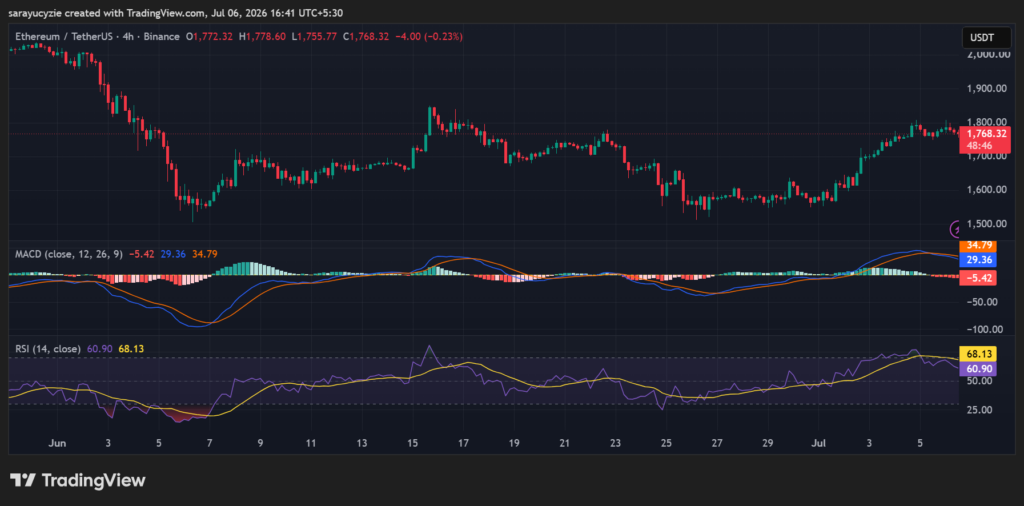
The daily Relative Strength Index (RSI) of Ethereum is stationed at 60.90, indicating a bullish momentum. It is showing that the buyers continue to have the upper hand, and it remains below the 70 threshold, with enough room for the price action to move higher if the buying pressure remains steady.
On the other hand, Vitalik Buterin is pushing for changes that would make Ethereum’s consensus layer leaner, more efficient, and harder to surveil. He is proposing to cut unnecessary complexity to improve efficiency and reduce the resources that validators need to run.
Also, shield validator identities using zero-knowledge (ZK) cryptography, making it near impossible to link a validator’s deposit, staking activity, and withdrawal together. Resetting the trail so tracking a validator’s identity or activity over time becomes a much harder task.
Notably, if these changes go through, Ethereum validators could operate with stronger privacy, better security, and a more decentralised setup, all while the network runs leaner than it does today.
Crypto Market Highlights
Bitcoin ETF Outflows Stretch to 8 Weeks: Are Bears Tightening Their Grip?