
- China, Japan, South Korea and 11 ASEAN members agreed to establish an AMRO programme and working group on cross-border digital payments.
- Discussions will cover payment connectivity and digital asset rules, including stablecoins. No shared payment network or stablecoin has launched.
China, Japan, South Korea and the 11 ASEAN member states have agreed to establish a regional working group to improve cross-border digital payments and discuss regulatory approaches to digital assets.
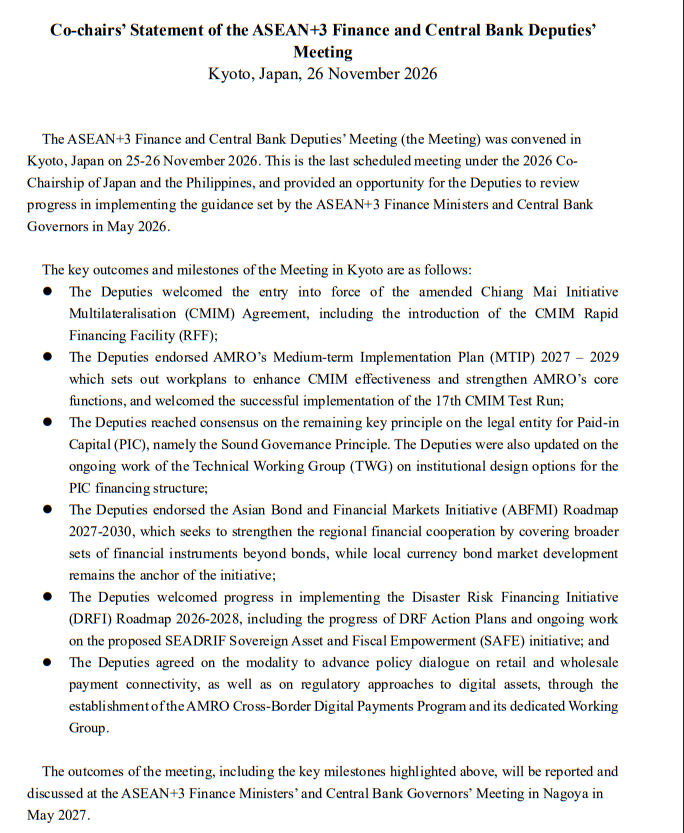
The agreement was reached at the ASEAN+3 Finance and Central Bank Deputies’ Meeting held in Kyoto, Japan, on November 25 and 26. Japan’s Ministry of Finance confirmed that participating officials had agreed to establish a new programme under the ASEAN+3 Macroeconomic Research Office (AMRO), along with a dedicated working group.
The initiative aims to improve connections between domestic payment systems so individuals, businesses and financial institutions can transfer money across borders more easily. The discussions will cover both retail and wholesale payments, as well as regulatory approaches to digital assets.
The agreement follows earlier discussions at the ASEAN+3 finance ministers’ meeting in May 2026, where officials called for stronger regional cooperation on payment connectivity and stablecoin regulation.
Stablecoins and digital asset rules included in discussions
The new programme will examine how participating economies can make their payment systems work more effectively together. This includes addressing differences in payment infrastructure and regulatory requirements that can make international transactions slower or more complicated.
Stablecoins are also part of the wider discussions. These digital tokens are generally designed to maintain a stable value by tracking currencies such as the US dollar. Officials have previously identified the need to coordinate regulatory approaches as their use in financial transactions grows.
However, the agreement does not mean the participating economies have launched a shared payment network, approved a common stablecoin or agreed on unified cryptocurrency regulations. The programme is intended to support policy discussions and cooperation between authorities.
The Kyoto meeting also covered wider regional financial stability measures. Officials welcomed changes to the Chiang Mai Initiative Multilateralisation, a $240 billion currency-swap arrangement that provides financial support to participating economies during periods of economic stress. Its revised framework includes a Rapid Financing Facility to speed up emergency funding.
The outcomes of the Kyoto meeting will be presented to finance ministers and central bank governors at their next gathering in May 2027 in Nagoya, Japan.