



- Vitalik Buterin described how cryptographic obfuscation would be able to help blockchain platforms keep their program logic safe.
- While there have been some advancements, today’s obfuscation techniques are still too inefficient to use in blockchains.
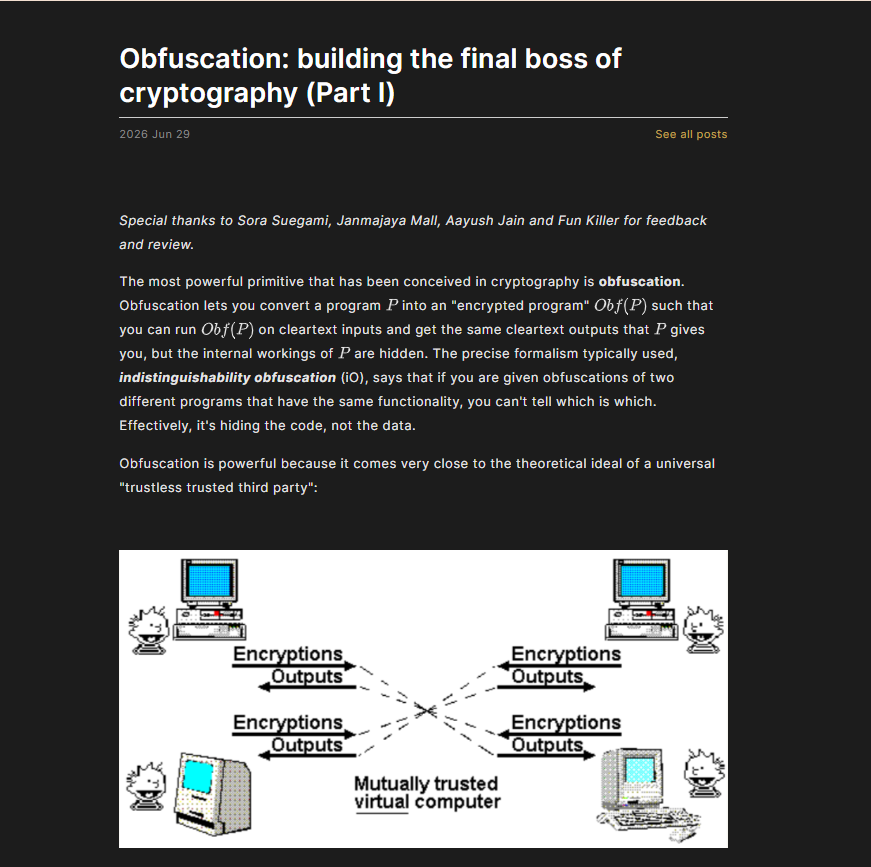
Ethereum co-founder Vitalik Buterin released a comprehensive piece describing Obfuscation in crypto industry. He explained how cryptographic obfuscation could strengthen blockchain privacy and security in the future. Obfuscation converts ordinary code into an encrypted form while allowing it to produce the same output.
As opposed to encryption that secures stored or transmitted information, obfuscation protects code itself. This is donefrom being analyzed by any user who tries to look at it and understand how it works.
This would allow the developer to develop applications using information which would remain secure. Without having to divulge any proprietary code or business logic. He stated that obfuscation along with blockchain technology could create systems which would maintain the privacy of the users. And while making less use of central authorities for their services.
Blockchain Could Enhance the Capability of Obfuscation
Obfuscation alone is not sufficient to securely handle digital assets like cryptocurrencies since users can simply duplicate obfuscation. Hence, it would not be possible to handle the balance and ownership through obfuscation alone.
However, blockchain networks have an inherent capability of recording ownership and transactions in the form of distributed ledger technology, which makes it suitable when combined with obfuscation to create applications that are able to prove ownership while hiding program logic. As stated by Buterin, this combination would enable secure payment systems, finance applications, confidential business operations, and many other blockchain applications.
Technical Difficulties Impede the Practical Application of Obfuscation
Buterin stated that researchers made considerable progress in an area called indistinguishability obfuscation, which seeks to make it impossible for an outside observer to distinguish among several programs generating the same output.
While researchers have already demonstrated that such obfuscation is possible by assuming certain accepted levels of security, the efficiency of those implementations is extremely poor. According to Buterin, some techniques currently employed are so resource-consuming that their execution would take longer than the lifetime of the universe.
There are still several techniques being researched by scientists that would help improve the efficiency of the algorithms. They involve optimizing currently used cryptographic methods, improving the mathematical tools, and even employing entirely novel approaches outside the existing framework.
Buterin concluded that practical obfuscation will take considerable time before becoming feasible, but further improvements will enable creating highly secure blockchain-based products that would not require the involvement of any trusted third parties.
Highlighted Crypto News:
India’s USDT Premium Surges Above 8.5% as Stablecoin Supply Tighten