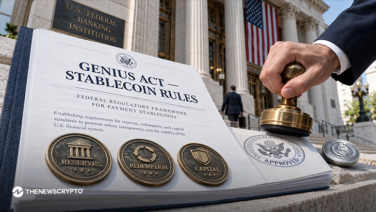



- Discussions on the regulation of stablecoins between US and UK officials took place in London.
- There is agreement on the need to fully require one-to-one stablecoin reserves.
- The issue of cooperation in cross-border regulation and market access was raised.
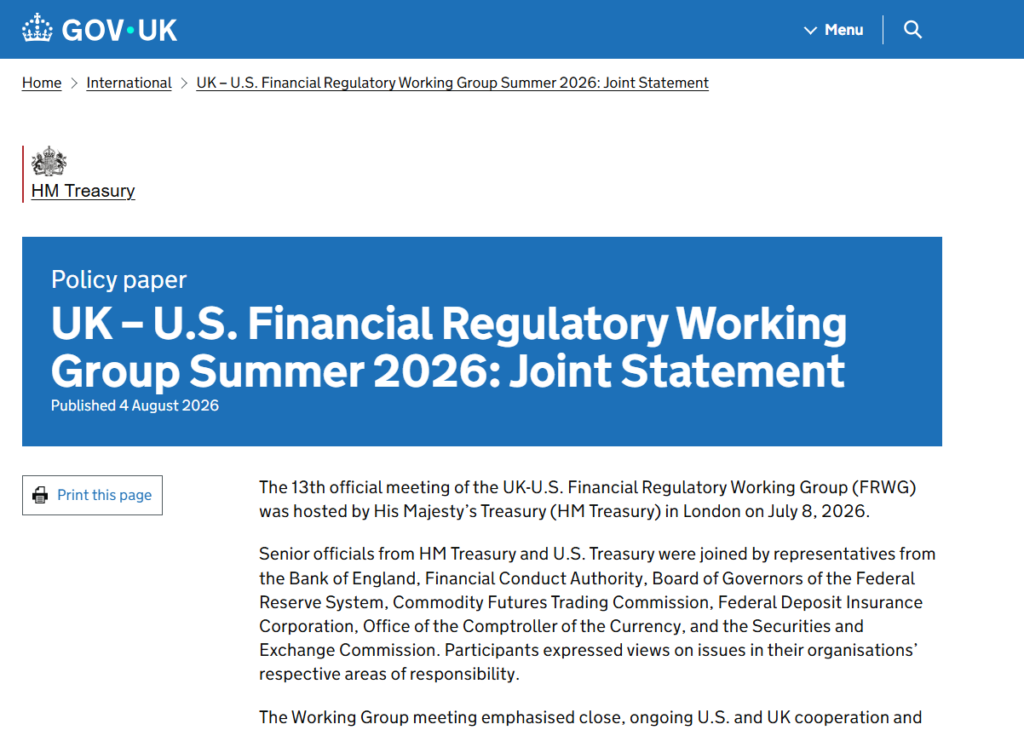
The two countries have been ramping up their efforts related to the regulation of stablecoins because both countries are in the process of refining their regulations concerning digital assets. A delegation from HM Treasury and US Treasury met in London on July 8 for the 13th session of the Financial Regulatory Working Group between the UK and US. The participants in this meeting included members from the Bank of England, FCA, Federal Reserve, SEC, CFTC, FDIC, and OCC. No proposals of rules were made in this meeting, only alignment of regulatory principles.
Stablecoins Go from Law to International Cooperation
Digital finance continued to be at the heart of the London summit of US and UK regulators. Where US regulators provided an update on the implementation of the GENIUS Act. This introduces the federal framework for payment stablecoins, as well as broader digital assets market reform. The British regulators provided information on the progress made in the development of Wholesale Financial Markets Digital Strategy, as well as the designation of Christopher Woolard as Wholesale Digital Markets Champion.
The regulators also discussed tokenization, payment innovations, and G20 Cross-Border Payments Roadmap. Both countries confirmed their commitment to responsible development of digital assets and consumer protection and financial stability in this area. At the same time, they support stablecoins backed one-for-one with liquid assets.
Restrictions Relaxed by Bank of England
The UK is still in the process of creating its regulatory framework for stablecoins. The Bank of England has already made some adjustments to certain proposals due to consultations with industry representatives. These amendments reflect efforts to balance financial stability with the practical use of stablecoins. In particular, an adjustment was made to the proposed limitations concerning individual holdings. Initially, the central bank proposed to limit the amount of stablecoins that an individual user can hold, but now this requirement is no longer in place. In addition, the Bank of England has introduced a temporary cap for annual issuance of systemic stablecoins. The current cap amounts to £40 billion per year and serves as a way to increase protection of the market in question.
The Bank of England has also decreased the required reserve ratio of the deposits of non-interest-bearing type kept at the central bank. Originally, issuers were required to hold 40% of their assets as such deposits. In the new system, the ratio was reduced to 30%, allowing more flexibility to the issuers in terms of reserve management.
According to the new system, stablecoin issuers could maintain up to 70% of their reserves in the form of UK government securities. Such an amendment may increase flexibility, but will still provide issuers with significant shares of highly liquid government assets. Taken together, these amendments show more flexible regulation of stablecoins. At the same time, this system brings the UK system closer to the emerging transatlantic one.
Highlighted Crypto News:
FBI Agent Charged in $1M Crypto Theft After Allegedly Using ChatGPT to Plan Escape