

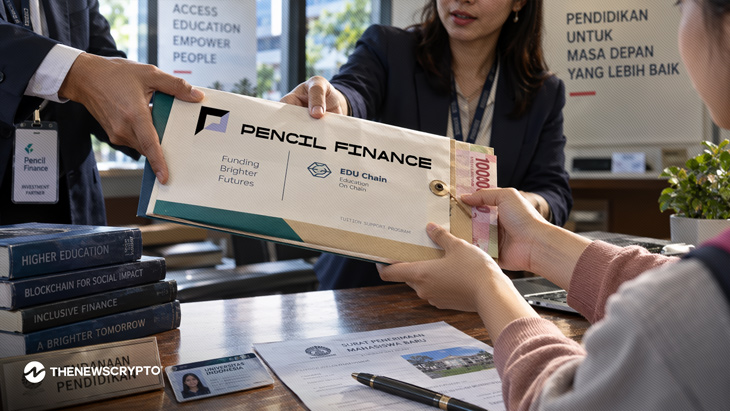
- Pencil Finance has completed a $1 million onchain cycle of student lending, financing 6,600 students in 118 institutions in Southeast Asia.
- The cycle had 1,050 borrowers directly receiving the funds and investment from Animoca Brands, Open Campus, and New Campus.
Pencil Finance completes a $1 million on-chain student lending cycle in Southeast Asia. The milestone helps link the blockchain-based lending services to students who traditionally do not have access to financing options. Pencil provided the funds as a lender and managed to track the whole lending cycle on-chain. The borrowers paid back their debts, which helped the platform to repay the capital and interest to the original investors.
$1M Loan Cycle Benefited 6,600 Students
In all, the loan cycle helped around 6,600 students from 118 different institutions in Southeast Asia. Approximately 1,050 students received direct financing under the cycle. Moreover, Pencil Finance specifically designed the loan cycle to support students who lacked access to traditional financing. 50% of the borrowers were women. Students from poorer backgrounds made up 93% of the borrower population.
These statistics show how the loan cycle targeted students with limited access to financing options. However, the use of blockchain technology gave a clear view of the loan cycle. The company claimed that this loan cycle was their first onchain student loan cycle. Pencil referred to it as the first-ever onchain student lending cycle on the blockchain networks.
Financing Structure Supported by Animoca Brands
July 2025 saw the participation of Animoca Brands, Open Campus, and New Campus in the funding of the loan bundle. In the structure of the loan bundle, senior and junior tranches were used to segregate returns and risks. The senior tranche provided fixed returns for participating funders, while the junior tranche had variable returns and first-loss risk. Pencil then allocated the $1 million to fund students before the end of the repayment cycle. Repayments by borrowers were used to repay the funders in the bundle. This is an example of how blockchain technology can track lending from allocation to repayment.
RWA Lending Goes Beyond Traditional Collateral
The financing process in Pencil’s case also highlights the growing use of tokenized real-world assets in lending markets. Moreover, RWA platforms are increasingly connecting physical and financial assets with blockchain-based financing systems. As a result, this approach could further integrate traditional lending structures with blockchain technology. The latest development has seen collateral tokenization take an unusual turn.
This month, B3, the Brazilian stock exchange, offered a loan of 100,000 Brazilian reais backed by 10 tokenized cows as collateral for the financing process. The tokens were individually created for each cow, and each animal had its encrypted digital identity. Cowmed AI-powered smart collars tracked each cow’s condition during the financing period. Such processes demonstrate how blockchain technology can be used to link the two–lending and real-world assets. In the Pencil’s case, the financing process involves using the same technology for student loans across Southeast Asia.
Highlighted Crypto News:
SEC Chair Paul Atkins Unveils New Rules to Bring Crypto Firms Back to the U.S.