


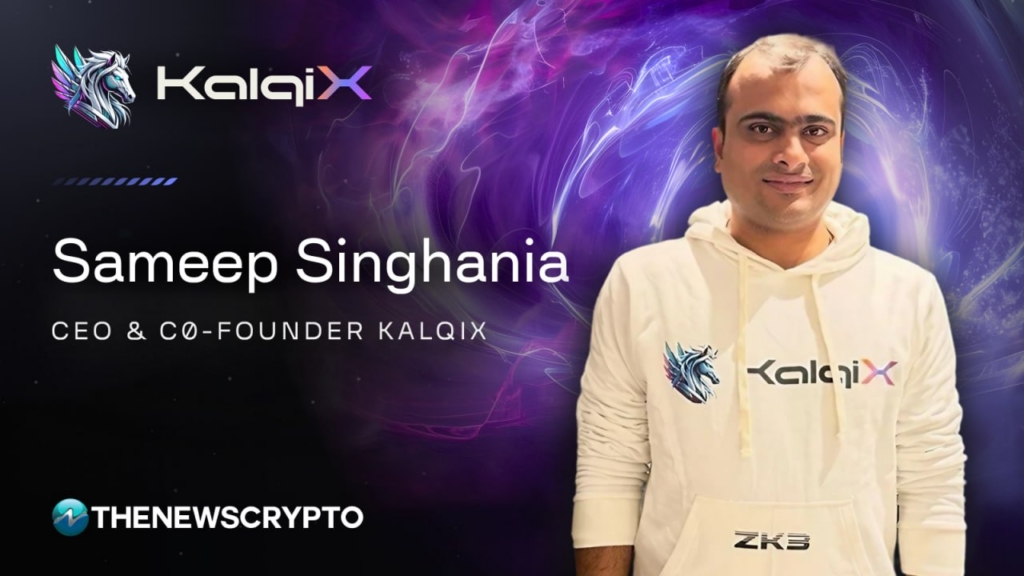
The Web3 and DeFi landscape is constantly evolving, and few entrepreneurs have been at the forefront like Sameep Singhania. From founding QuickSwap to launching KalqiX, Singhania is working to bridge the gap between traditional finance and decentralized systems. In this interview, he shares his insights on the current state of Web3, the challenges and opportunities in DeFi, and how KalqiX aims to create a seamless, trustless trading experience for users and institutions alike.
Q. At this stage in the plight of Web3 technologies, many believe crypto has fallen on hard times, and that innovation and sentiment are declining. Where do you stand on the state of Web3, and what kind of impact are you trying to make with KalqiX?
Ans: This has been said multiple times in the history of crypto and every time, the industry has come back stronger. If you zoom out, the trend is very clear: crypto is still growing, both in adoption and in real-world relevance.
Web3 today is actually in a much stronger position than before. We’re now seeing real applications like Polymarket proving that blockchain can solve real-world problems, not just speculation.
With KalqiX, we’re trying to take things to the next level. Our goal is simple: build a DeFi ecosystem with a user experience as smooth as something like Robinhood.
We want to remove the friction between Web2 and Web3. Ideally, users shouldn’t even realize they’re using blockchain; they should just use the product because it works better. That’s the standard we’re aiming for.
Q. During the DeFi summer of 2020, many pundits made bold claims that DeFi was destined to replace commercial banks, and much of traditional finance altogether. Today, it appears DeFi still lacks the performance to compete with a lot of traditional platforms. Do you still believe DeFi has what it takes, and what role can KalqiX play in helping DeFi to raise its level?
Ans: I don’t think DeFi or Web3 is here to replace traditional finance, it’s here to evolve it.
Just like technology evolves over time, financial systems evolve as well. DeFi brings transparency, programmability, and global access, things traditional systems struggle with.
That said, performance and usability have been real bottlenecks so far. And that’s exactly where KalqiX comes in.
Our goal is to build a trustless financial ecosystem where anyone can trade seamlessly without needing to understand blockchain. We’re removing the entry barrier completely.
If we get this right, DeFi doesn’t compete with TradFi, it provides an upgrade.
Q. Where do you expect to see KalqiX make its biggest breakout?
Ans: I think KalqiX’s biggest breakout won’t just be in technology, it will be in distribution.
KalqiX is fully white-label ready. That means any team, even non-technical or semi-technical, can launch their own branded exchange with their own UI, logo, and community.
They bring users. We provide liquidity, execution, and zk infrastructure.
So instead of competing as a single brand, KalqiX becomes the execution layer behind multiple exchanges.
All of them contribute volume back to the same core protocol creating a network effect that compounds over time. That’s where things get really powerful.
Q. You’ve been a successful founder in this industry before. How has founding, incubating, and growing QuickSwap informed your perspective on leading a successful DeFi startup?
Ans: Building QuickSwap changed my mindset completely. I started as a tech-first person, but over time I became much more product-focused. Now I think in terms of user experience, not just technology.
One key learning was this: products don’t succeed because of technology alone, they succeed because users actually want to use them.
And for that, the product has to be simple, fast, and reliable. The other big learning was partnerships. In DeFi, integrations and ecosystem relationships matter a lot. The stronger your network, the faster you grow.
Q. Are there any major strategic changes you’re implementing from your previous experiences as a DeFi founder as you bring KalqiX to market?
Ans: One major shift is reducing dependency on third-party providers for core technology.
In Web3, every serious company is fundamentally a tech company. If your core infrastructure depends too much on others, it can slow you down or even become a risk.
With KalqiX, we’re building and controlling as much of the core stack as possible, especially execution and proving infrastructure.
That gives us speed, flexibility, and long-term stability.
Q. Let’s talk about zero-knowledge. How would you describe the innovative potential of zero-knowledge proofs to less experienced users?
Ans: The simplest way to think about zero-knowledge is this:
You can prove something is true without revealing the underlying data. In finance, that’s extremely powerful.
It means you can have:
- Privacy (your trades and balances aren’t exposed)
- Security (everything is cryptographically verified)
- Trustlessness (no need to rely on intermediaries)
For KalqiX specifically, zk allows us to combine the best of both worlds: centralized exchange performance with decentralized security. That’s the real breakthrough.
Q. Most of our readers already know what an AMM DEX is, but far fewer know about KalqiX’s CLOB DEX. Tell us: what does “CLOB” stand for, and what are its implications for on-chain markets?
Ans: CLOB stands for Central Limit Order Book.
It’s the same model used by traditional exchanges where buyers and sellers place limit orders, and trades happen based on price matching.
Most DeFi exchanges today use AMMs (Automated Market Makers), where prices are determined by liquidity pools and formulas.
The problem with AMMs is:
- Slippage
- Inefficient pricing
- Poor capital efficiency
A CLOB solves all of that by enabling:
- Better price discovery
- Tighter spreads
- Professional trading strategies
The challenge historically was scalability which is why CLOBs didn’t work well on-chain.
KalqiX solves that using zero-knowledge proofs and high-performance infrastructure, making on-chain CLOB actually viable.
Q. MEV is another big DeFi buzzword, and a significant issue that impacts traders. What has KalqiX done to protect traders from MEV, and how does that impact their on-chain trading outcomes?
Ans: KalqiX moves sensitive trading information, intent, size, strategy, into a zero-knowledge layer.
The market can verify that trades are valid, fair, and correctly executed, without seeing the details. By doing that, we eliminate MEV bots and deliver blistering speed while staying on-chain and non-custodial.
The end result is:
- Fairer execution
- Better pricing
- More predictable outcomes for traders
Which is critical if you want serious traders to move on-chain.
Q. Lastly, if KalqiX is successful in its mission, what will DeFi look like 5 years from today? In what ways will traders benefit, and in what ways will the entire Web3 ecosystem benefit?
Ans: If KalqiX and similar systems succeed, DeFi in 5 years will look very different from today.
Users won’t think in terms of “DeFi vs Web2” anymore. They’ll just use the best products and those products will be powered by blockchain underneath.
For traders:
- Faster execution
- Lower costs
- Better liquidity
- More privacy
For the ecosystem:
- More real users, not just crypto-native users
- More institutions entering the space
- A shift from speculation to actual utility
And most importantly trustless systems will become the default, not the exception.
That’s the future we’re building towards.
Disclaimer: The information provided in this interview article is for informational purposes only. It is not intended to be, nor should it be construed as, investment advice, financial guidance, or a recommendation to make any specific decisions. Readers are encouraged to conduct their own research.