



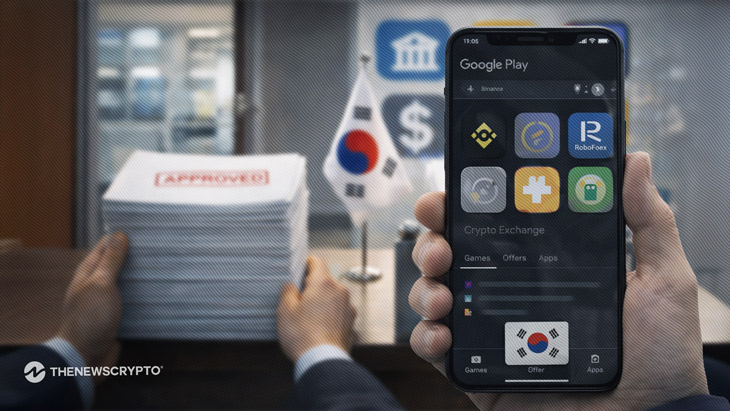
- Google Play will require FIU VASP registration proof for crypto apps in Korea starting Jan. 28.
- Offshore exchanges like Binance and OKX could face app download restrictions without local clearance.
- The enforcement contrasts with South Korea’s progress on tokenized securities regulation.
Google is rolling out stricter crypto app requirements in South Korea, a change that could sharply limit access to offshore exchanges by linking app availability to local regulatory approval. The update raises compliance pressure on foreign platforms that serve Korean users without completing the country’s formal registration process.
According to South Korean media outlet News1, starting Jan. 28, crypto exchange and wallet apps listed on Google Play in South Korea must upload documentation proving that their Virtual Asset Service Provider (VASP) registration with the country’s Financial Intelligence Unit (FIU) has been accepted. Google will require developers to submit the proof through the developer console as part of app eligibility. Apps that fail to meet the requirement could lose access in South Korea, which would block new downloads and create disruption over time.
Binance and OKX could face app lockouts
The policy change could hit major overseas exchanges first. Reports highlighted Binance and OKX as platforms that may struggle under the new Google Play enforcement. South Korea already requires exchanges that serve domestic users to register with the FIU. However, offshore exchanges often find that process is difficult, expensive, and slow.
South Korea’s FIU registration process typically forces exchanges to build local operations and compliance systems. Firms usually need to set up a Korean legal entity, implement anti-money laundering controls, complete on-site regulatory checks, and secure ISMS certification (Information Security Management System). These steps create high barriers for foreign platforms.
In the Asian markets, Binance has an ownership stake of 10% in the South Korean exchange company named Gopax. But it does not have an officially recognized entity operating within the country. OKX has also had allegations of operating without being registered in the past.
A Binance spokesperson said the exchange is indeed aware of the development, and the new policy does not only target Binance, but many other crypto apps. The spokesperson warned that users who switch devices, perform factory resets, uninstall the app, or trigger re-installation through OS updates “may temporarily be unable to re-download” the app after the policy takes effect. Binance said it is engaging Google to reach a constructive resolution. OKX declined to comment.
Google ties crypto apps to local licensing standards
Google’s move reflects broader enforcement of its global crypto policy rather than a sudden directive from Korean regulators. In recent years, Google Play has steadily pushed crypto exchanges and custodial wallet providers to comply with licensing rules in each jurisdiction where they operate.
Google Play updated its Cryptocurrency Exchanges and Software Wallets policy to require exchanges and custodial wallet apps to meet local licensing and regulatory standards in specific countries. For example, U.S.-based operators must register with agencies such as FinCEN, while EU-facing providers must comply with the region’s crypto-asset licensing frameworks.
Now, South Korea has become the next major jurisdiction where Google enforces app-store compliance through licensing verification.
Strict app enforcement contrasts with Korea’s tokenization progress
The tighter Google Play gatekeeping arrives while South Korea pushes forward on regulated blockchain adoption in capital markets. The National Assembly has passed amendments related to the Electronic Securities Act and the Capital Markets Act, creating a framework that recognizes tokenized securities and allows regulated issuance and distribution.
That contrast is striking. On one side, the country is modernizing its financial infrastructure through tokenization. On the other hand, authorities and platform gatekeepers are restricting unregistered crypto service access through enforcement rails like app stores.
Ultimately, Google’s updated requirement could reshape South Korea’s user access landscape. If offshore exchanges cannot meet FIU registration standards, Korean traders may increasingly shift toward locally licensed platforms, whether they prefer them or not.
Highlighted Crypto News:
CME Group Plans to Expand Crypto Derivatives With ADA, LINK, and XLM Futures in February